Cobra Posture in Yoga: Everything You Need to Know
A practical guide to cobra posture in yoga, with a setup table, smaller options, plus official NIH NCCIH safety notes on learning this pose with care.
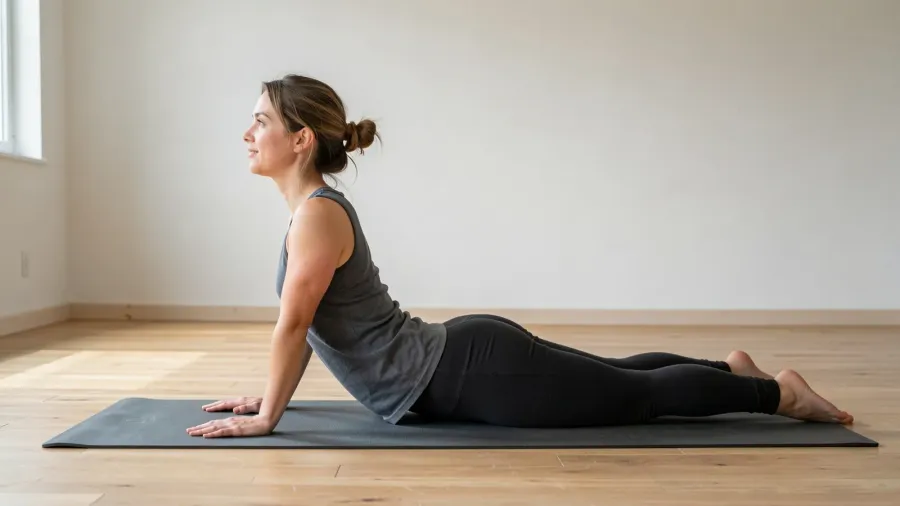
A small backbend, done on purpose, is enough
Cobra posture in yoga is often photographed at full height, chest open, arms straight, face calm. On a living-room floor the useful version is usually lower, shorter, and quieter. You lie on your front, use the hands as a modest support, and lift the chest only as far as the back and the breath remain ordinary. If the lower back shouts, or the elbows have to lock for the picture, you have already gone past the point of the pose.
The National Center for Complementary and Integrative Health, part of NIH, says yoga is generally considered a safe activity for healthy people when it is practiced appropriately under a qualified instructor, and that injuries still happen, often as sprains and strains. Learning without supervision has been associated with increased risk. People who are pregnant, older, or living with a health condition should talk with their health care providers and a teacher, and yoga should not delay medical care. The short official list is here: 5 things you should know about yoga. This page is a setup guide, not a treatment for a “bad back,” and it is not a posture-correction program.
If a clinician or a teacher has already asked you to avoid lying on your front, or to avoid backbends, that instruction wins.
What you are buying with your time, not with a prop
The pose itself needs a mat or a carpet you will not slide on, and enough floor to lie down. A folded blanket under the hips can make the shape more comfortable. You do not need a special cobra strap, a branded kit, or a deep backbend tutorial as a first purchase. A single class, or a few minutes of in-person teaching, will usually do more for this pose than a new object.
“Yoga and posture,” as a search, often hopes that one shape will undo a day of sitting. A modest cobra can be a pleasant way to move the spine in the other direction from a chair. It is not a substitute for changing how long you sit, or for care you already need. Treat it as one movement among others, and keep it small.
A setup table, from the floor up
| Step | A conservative way to do it | A measured check | Stop or shrink the pose if |
|---|---|---|---|
| Lie down | Front on the mat, legs at a comfortable distance, tops of the feet on the floor if that is easy | You can breathe into the floor without holding still in a stiff way | Lying on the front is painful, or a clinician has said to avoid it |
| Place the hands | Palms under or slightly forward of the shoulders, fingers spread, elbows bent and relatively close | You could lift the hands a millimeter and the chest would not collapse in a panic | The shoulders creep up to the ears and will not go down |
| Lift a little | Press the pelvis gently toward the mat, lengthen the back of the neck, lift the chest only a small amount | The lower back feels like work, not like a pinch; the breath is still ordinary | You feel pinching in the lumbar spine, or you are holding your breath to stay up |
| Use the arms as a support, not as a jack | Keep a bend in the elbows unless a teacher has already given you a higher version that remains comfortable | You could stay for a few breaths without trembling or gripping the jaw | Straight arms are the only way the chest will lift, and the back objects |
| A smaller option | Forearms on the mat, chest lifted only a little (often taught as a gentler cousin of cobra) | This already feels like enough | You treat the smaller option as a failure and yank up anyway |
| Come down | Lower slowly, turn the head, and rest on the front or the side | You feel no worse after a minute on the floor | Anything sharp remains; then you stop for the day and, if it persists, you get advice |
Do not take the feet off the floor to “get more lift.” Do not roll the shoulders back so hard that the neck cranes. Do not bounce.
A short, cheap practice you can actually repeat
After a walk, or after a lot of sitting, lie down and try two or three small lifts, with a rest between them. That is a complete session. If you already have a class, ask the teacher to watch your cobra once and to give you a height you can use at home. Then ignore photographs that are higher than that height.
If you practice other floor poses, keep cobra away from a long, lazy slump in a deep push-up shape unless you have been taught a sequence and you can do it without dumping into the lower back. Many sun-salute versions pass through a low or a higher backbend; the same rule applies there: height is not a score.
Time is the main cost. Two careful minutes beat a ten-minute argument with a video. If the pose is not for you, a walk and a change of sitting position will do more for comfort than a forced cobra, and they cost nothing.
A checklist before you lift the chest
- A clinician or teacher has not already ruled this shape out
- The floor is stable, and I can lie on my front without pain
- I will lift less than the photograph
- I can keep an ordinary breath
- I have a smaller forearm-based option if I need it
- I will stop if I feel a sharp or pinching sensation
- I will not use this pose to postpone care for a back problem
Questions that come up once the picture looks “easy”
How high should cobra posture be?
High enough that the chest feels lightly lifted, and no higher than you can hold with a quiet neck and an ordinary breath. For many beginners, that is a low cobra. Height is not the aim.
Can cobra “fix” my posture?
It can be one way to move after sitting, if it is comfortable. NCCIH discusses yoga in general as a practice that may have benefits for some kinds of pain and for aspects of well-being, but that is not a prescription for this pose, and it is not a reason to skip a clinician if you have a posture or pain concern. Everyday habits — how long you sit, how you lift, whether you walk — will usually matter more than one backbend.
Should I do cobra if I have a sore lower back?
Not on the strength of this article. Ask a health care provider or a qualified teacher who can see you. If anything about lying on your front or bending backward has been discouraged, skip it.
Do I need a teacher for a pose this common?
A teacher is still the cheaper first step if you can get one, because common poses are easy to overcook. If you practice at home, stay in the conservative column of the table and treat discomfort as information, not as a barrier to push through.